The best equipment for pros and enthusiasts alike



 Professions
Today, the National Gendarmerie has just over 250 divers in its ranks. The majority of them work as underwater investigators for the departmental gendarmerie. Each year, many candidates attempt to join this specialty but places are scarce and, even if they pass the entrance tests, candidates must still survive very intensive training.
Summary:
The missions of a specialist diver within the National Gendarmerie are multiple. We mainly find:
The search for objects that may constitute evidence or proof in judicial investigations (weapons, ammunition, explosives, stolen objects, vehicles, drugs, ...).
The search for missing persons.
Rescue of people in danger during natural disasters.
The securing of sensitive areas during visits by dignitaries.
These underwater investigators can operate in different environments. In river brigade, gendarme divers intervene in rivers, lakes, ponds and streams while in coastal brigade, Gendarmerie divers intervene at sea or in the ocean.
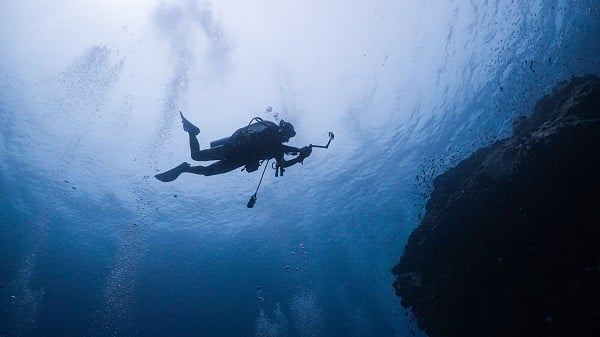
The Gendarmerie divers are first and foremost military personnel, gendarmes who have specialized. They therefore need the same qualities as their colleagues in brigades or squadrons, namely:
Analytical ability
Rigor
Physical capabilities
To this are added specific qualities. Indeed, the investigator diver must above all be an excellent swimmer. In aquatic environments, the diver must also redouble their sense of observation since evidence can be even more difficult to find than at a crime scene on dry land. Their technical mastery of finning must be excellent to avoid any risk of destroying evidence and to avoid clouding visibility. Finally, Gendarmerie divers are regularly exposed to extreme working conditions (water temperature, very reduced visibility, waves, ...), which requires excellent physical condition and mental strength.
To become an underwater investigator of the National Gendarmerie, candidates must pass national tests organized by the National Nautical Instruction Center of the Gendarmerie (CNING). Although it is not absolutely necessary to have civilian diving experience, it goes without saying that this helps candidates endure the intensity of this training with greater serenity.
Candidates must be medically fit and be a maximum of 35 years old on December 31st of the year of entry into initial training. Pre-tests may sometimes be organized.
Subsequently, candidates undergo national tests which generally include four trials:
800 meters with fins, mask and snorkel, without using arms;
50 meters of oral-nasal dissociation;
100 meters without fins of aquatic course with two breath-holding phases of 15 meters;
A 5-minute stationary sustentation while finning with a 2 kg weight above the head.
Candidates selected following these national tests will then enter initial training.
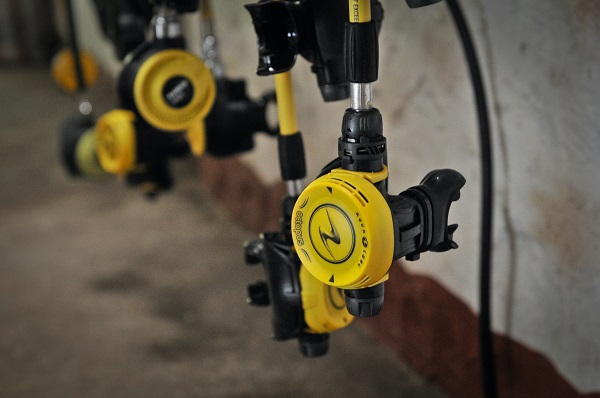
The initial training lasts six weeks at the Navy Diving School at Saint-Mandrier in Var (83). At the end of this course, military personnel obtain the "ship diver" diploma for the departmental gendarmerie. GIGN gendarmes are awarded the "intervention diver" diploma.
The additional training must be completed within the 18 to 22 month probationary period. It lasts four weeks and the location and content differ:
GIGN Divers: a course at the Saint-Mandrier school allows them to master closed-circuit diving in the context of their offensive underwater missions.
Departmental Gendarmerie Divers: divers undergo training at the National Nautical Instruction Center of the Gendarmerie (CNING) in Antibes (06) which includes a theoretical part and practical exercises in sea and fresh water to receive the underwater investigator diploma.
Note: the profession of diver in the Gendarmerie requires continuous training throughout the military personnel's career due to the high technicality of their missions.
To become an underwater investigator of the Gendarmerie, one must have at minimum the status of non-commissioned officer of the gendarmerie but the diver can also be an officer of the gendarmerie. The salary therefore depends on the status, rank and level of the military personnel as well as their marital and family status.
After obtaining the underwater investigator diploma, Gendarmerie divers can specialize again by obtaining the Underwater Investigation Technician diploma (DTIS) by following a 3-week training at the CNING in Antibes. This training will allow them to take on greater responsibilities and investigate larger-scale crime scenes. Eventually, gendarme divers can also orient themselves toward an instructor career.
On our online store, you can find thousands of clothing, equipment, gear, luggage, shoes, accessories and badges for all gendarmes. Find all our gendarmerie products as well as a large selection of brands at the best quality/price ratio on the market.