The best equipment for pros and enthusiasts alike







New Standard
-15%
 Professions
The decree of July 18, 2023 introduces crucial directives for the uniformity and identification of private security agents. It specifies the rules concerning identification elements on the chest and back, as well as the exception for airport security agents.
Table of Contents:
- Analysis of the July 18, 2023 Decree
- Scope of application of the new uniform directives
- Placement of identifiers on the chest
- Placement of identifiers on the back
- Exemption granted to airport security agents
- The implementation of the decree: A transitional period post-2024 Olympics
In the field of private security, uniformity and identification play a crucial role. Not only do these elements contribute to the operational efficiency of security agents, but they also strengthen public confidence by ensuring immediate and clear recognition of their status. The decree of July 18, 2023, relating to private security agents' uniforms, establishes precise directives to guarantee this uniformity and identification.
At the heart of these directives is the individual identification number, a crucial element of agents' uniforms. This number, printed in Arial 36 characters, represents the last seven digits of the unique beneficiary number present on the agent's professional card. Its visibility is paramount, with a requirement for printing in black on a white background, or vice versa, to ensure quick and easy identification of agents in the field.
In addition to the individual identification number, each agent must display an insignia of the company for which they work. This insignia, in the form of a 50 mm square, represents the name or acronym of the company and helps identify the agent's affiliation. Strict standards govern its size and position to guarantee maximum visibility and immediate recognition of the agent's belonging to a private security company.

This new uniform regulation concerns several categories of private security agents. Firstly, it applies to human surveillance or security guard agents who are included in the scope of this regulation. Their mission encompasses electronic or human surveillance of movable or immovable property, as well as the security of persons present in these locations, including in public passenger transport vehicles. Compliance with the new identification requirements is therefore essential for these agents to ensure the security of the locations they monitor and the people present there.
Cash-in-transit guards are also among the agents concerned by this regulation. Their main mission is to ensure the protection and secure transport of valuables, whether currencies or other high-value goods. Their uniform must therefore comply with the standards established by the decree of July 18, 2023 to guarantee their easy identification during their missions.
Finally, security agents of security services for property management companies, such as GPIS (Paris Inter-landlord Surveillance Group) or GITeS (Inter-neighborhood Tranquility and Safety Groups). Their role consists of ensuring the security of real estate properties and guaranteeing the tranquility of occupants.

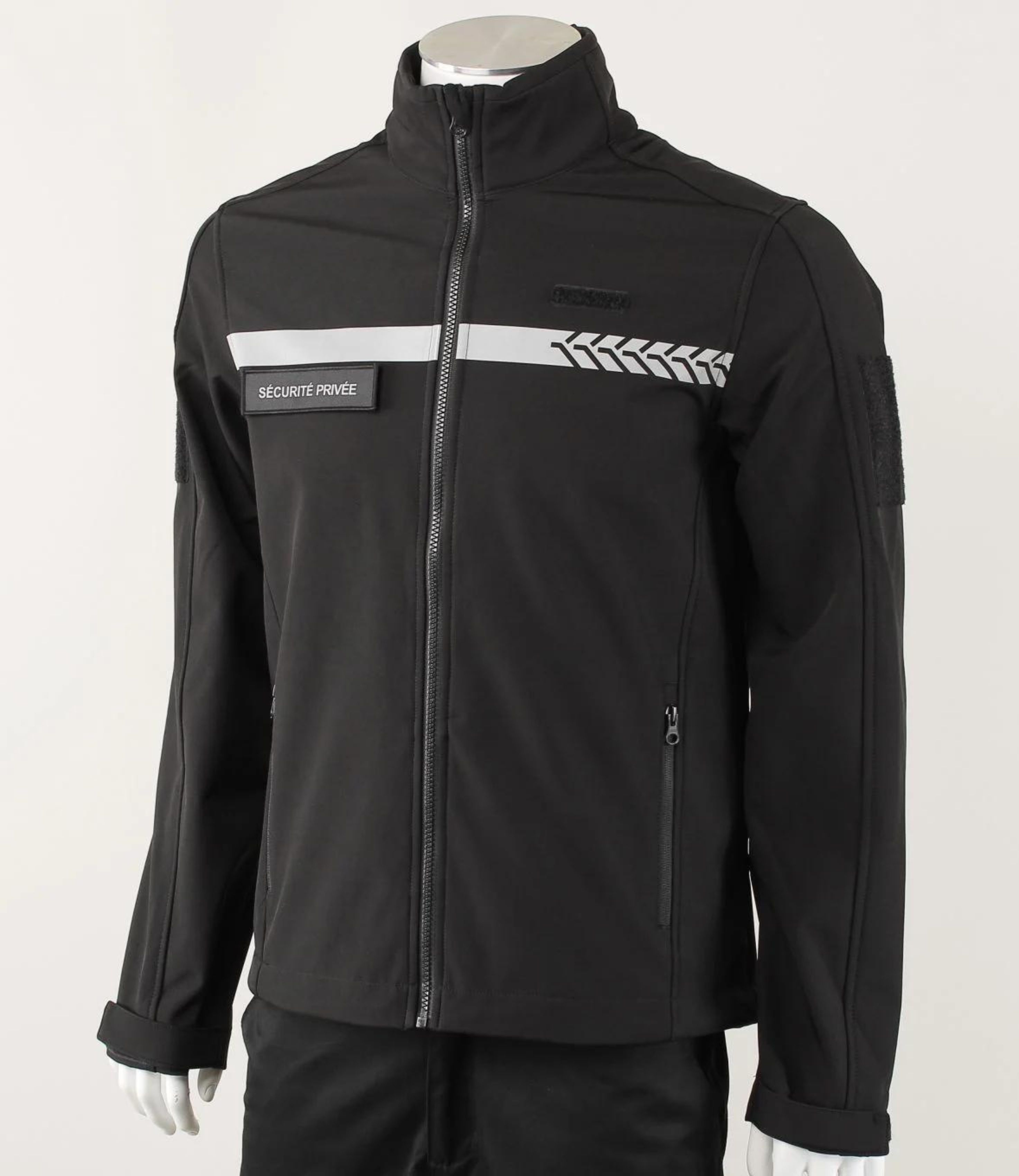
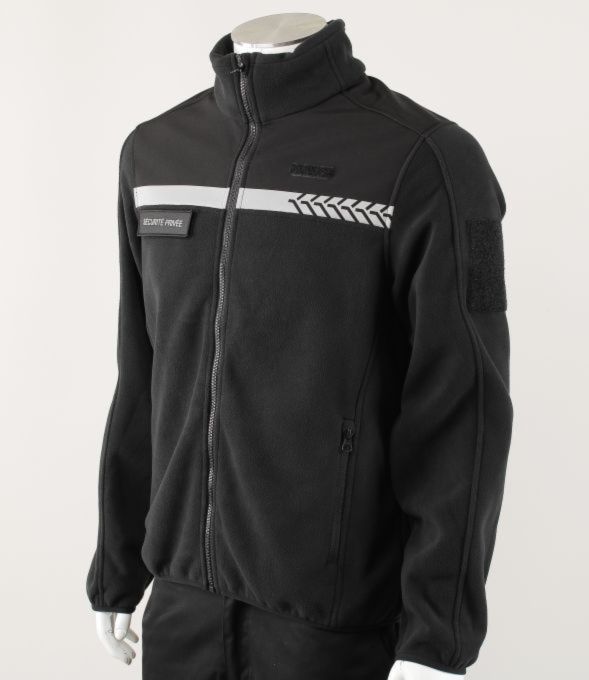
The decree of July 18, 2023 precisely stipulates the location and specifications of identification elements on private security agents' uniforms. On the chest, in the upper left, agents must display two main identifications.
As previously stated, the individual identification number must be printed in Arial 36 characters. This number corresponds to the last seven digits of the unique beneficiary number present on the agent's professional card, issued by the director of the National Council for Private Security Activities. The decree specifies that these characters must be black on a white background, or vice versa, to guarantee optimal visibility.
Furthermore, this number must be printed on a specific strip measuring 54 mm x 15 mm, thus ensuring uniformity and consistent readability of identification. The company insignia must be a square with a minimum side of 50 mm. This size guarantees optimal visibility and readability, regardless of the insignia's shape.
This provision aims to ensure that each agent is easily identifiable and that their professional status is immediately recognizable, thereby strengthening public confidence in private security professionals.

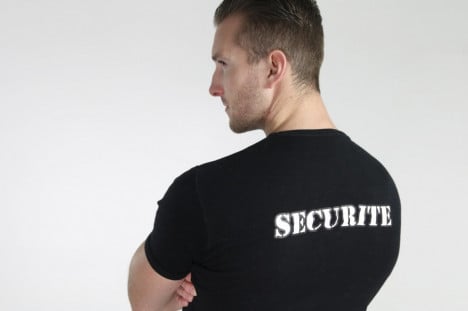
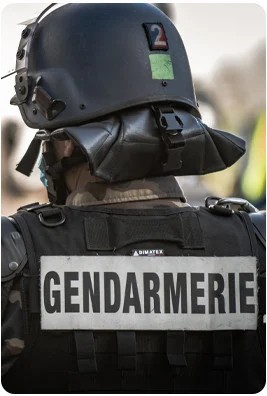
The decree of July 18, 2023 does not merely regulate the identification of private security agents on the front of their uniform, but it also stipulates specific requirements for identification on the back. Each agent must wear a clearly visible inscription bearing the mention "PRIVATE SECURITY" on their uniform.
To ensure optimal visibility, this inscription must be positioned on a centered horizontal line on the back of the uniform. Furthermore, to guarantee readability even in low-light conditions, the characters must be retro-reflective and in Arial 76 type in capital letters. This specific typography has been chosen to maximize the inscription's readability.
Regarding color, the characters must be white, on a black background. This high contrast allows instant recognition of the agent's function, thereby reinforcing their authority and presence with the public.
These provisions ensure that the agent's identity as a member of private security personnel can be clearly and easily recognized, regardless of viewing angle or lighting conditions. This not only reinforces the security of protected locations and persons, but also public confidence in these professionals.
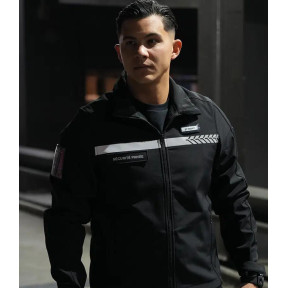
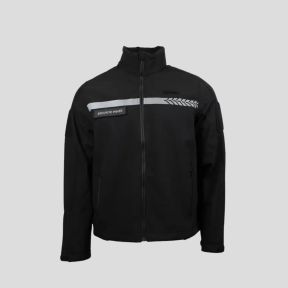
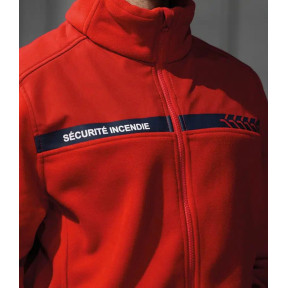
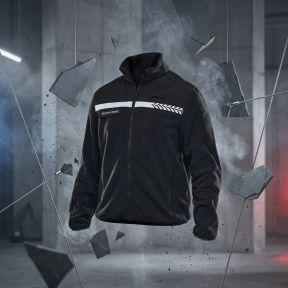
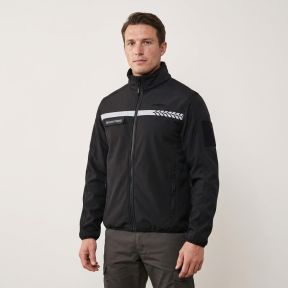
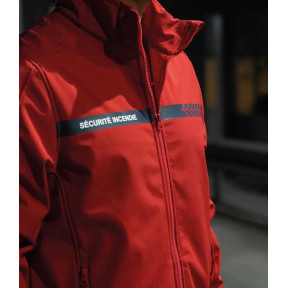
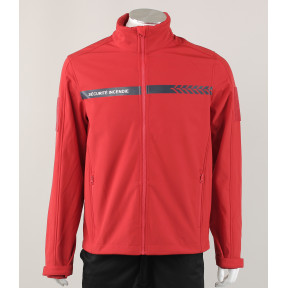
Here are the two Safetek by GK products, meeting this standard, now available for pre-order.
Private Security Softshell with HV strip Black - Safetek by GK
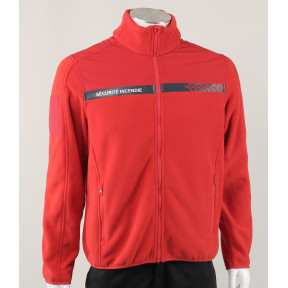
Private Security Fleece Jacket with HV strip Black - Safetek by GK
Airport security agents constitute a particular category in the field of private security, subject to specific regulations since 2014. Unlike other private security agents, they are not required to add the mention "PRIVATE SECURITY" on the back of their uniform. Their identification relies solely on displaying their individual identification number on the chest.
Since the introduction of this regulation, more than 11,000 airport security agents have been uniformed through a partnership with Paul Boyé Technologies, a specialized company. This standardization, the result of close collaboration between airport operators, security companies, trade unions and competent authorities, aims to standardize the uniforms worn by these professionals. The uniforms are available in two versions adapted to indoor and outdoor airport environments.
This standardization of airport uniforms offers several advantages. It highlights the crucial role of security agents in control procedures and reinforces their visibility and recognition among passengers and other airport employees. Furthermore, each uniform is equipped with a badge symbolizing the profession, which can be customized by security companies. This customization contributes to clear identification and enhancement of airport security agents, thereby reinforcing their professionalism and authority.

The implementation of the new decree regarding private security agents' uniforms will not be immediate, as stipulated in Article 6 of the decree, setting the effective date as October 1, 2024. This decision aims to provide a necessary transition period to allow various sector stakeholders to adapt to the new requirements.
This effective date is strategically chosen, occurring just after the conclusion of the 2024 Olympics. This international event highlights the crucial importance of security. The intermediate period that follows will thus allow for testing, adjusting and refining the new directives in an environment of very high requirements, offering a valuable opportunity to evaluate their effectiveness and practicality.
It should also be noted that this decree will apply in French overseas territories such as the Wallis and Futuna Islands, French Polynesia and New Caledonia. Although geographically distant from mainland France, these territories are concerned by these changes and must therefore comply with the new directives, thus ensuring harmonization of security standards throughout French territory.