 The best equipment for pros and enthusiasts alike
-
 Professions
-
-
-
-
-
-
-
-
All Tops
![All Tops]()
-
-
-
All Bottoms
![All Bottoms]()
-
-
-
All Footwear
![All Footwear]()
-
-
-
All Bags
![All Bags]()
-
-
-
All Accessories
![All Accessories]()
-
-






Respiratory protection masks are essential to protect workers from airborne particles, gases, vapors and harmful viruses to their health. Highlighted with the Covid-19 epidemic, respiratory masks are not only useful to medical professions but to all craftsmen and workers.
Depending on the professional environment and usage situations, the type of mask used varies considerably. Let's see together which respiratory mask to buy.
Summary:
- The different protection masks
- Surgical masks
- FFP masks
- N95 masks
- Filter masks
- Full masks
- Areas of activity
- Construction
- Industry
- Green spaces
- Medical
- How to put on a respiratory mask?

The different protection masks
The surgical mask
Defined by the EN 14683 standard, the surgical masks are divided into 3 categories :
Type i : bacterial filtration greater than 95%
Type ii : bacterial filtration greater than 98%
Type iir : bacterial filtration greater than 98% and more resistant to splashes.
Surgical masks are disposable masks and must be changed as soon as the inside of the mask is damp or every 4 hours. The surgical mask is only useful for limiting droplets, so they can be used in the medical environment without problem, however they should not be used to protect against volatile particles such as metallic or wood dust, chemicals, etc.
FFP masks
There are 3 types of FFP masks, each being more efficient than the other. They are nevertheless all standardized EN 140-1998 + A1:2009.
Make sure to choose your "Filtering FacePiece" (FFP) mask type according to your activity. FFPs are, like surgical masks, single-use masks, the same usage precautions apply.
"Anti-dust" masks FFP1 will stop 78% of particles, i.e. all large solid particles without toxicity such as cement, coal, graphite or glass wool dust.
FFP2 masks stop 92% of particles with a much finer filter allowing to filter fine and toxic particles such as mold, resins and metallic dust.
FFP3 masks are the most efficient with a 98% particle stoppage offering very high protection against very fine particles such as lead, concrete projections or asbestos.
The N95 mask
N95 type masks are anti-particle filtering protection masks meeting the American NIOSH classification. They filter at least 95% of airborne particles but are not resistant to oil or water. It is not capable of filtering gases and vapors, like FFP2 masks.
Of American origin, it is quite possible to obtain them in France and Europe, nevertheless, it will be preferable to use an FFP2, which responds to European classification.
Half-mask with filter cartridges
Resembling FFP or surgical masks in their coverage area, cartridge masks are reusable. You simply need to change the filters located at the front of the mask.
This type of standardized mask EN 140-1998 is used for prolonged use in saturated environments with dust or particles.
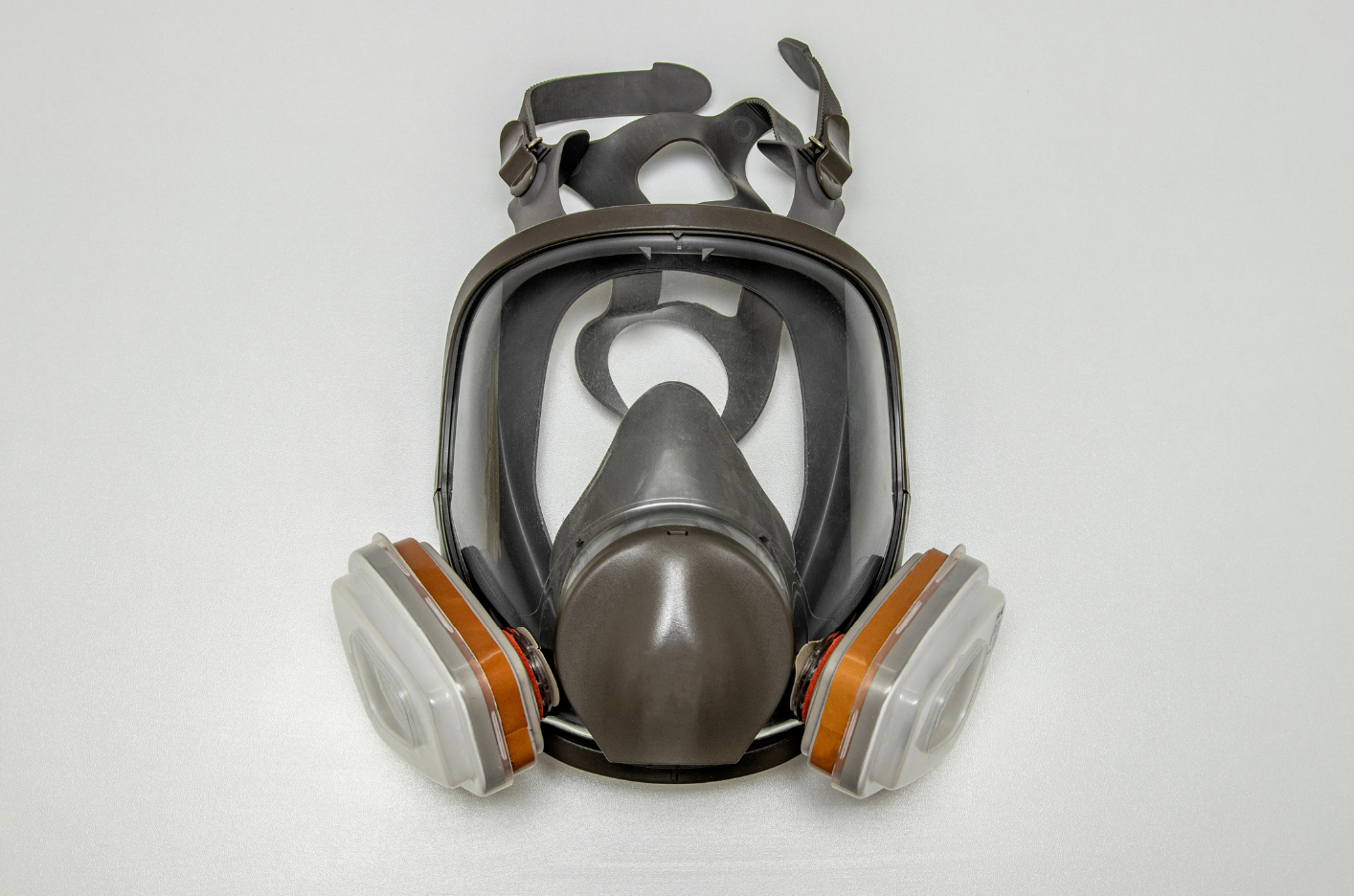
Full face filter mask
Covering the entire face, this mask is useful when it is necessary to protect not only the respiratory tract but also the contact surface with the product or particles. Full masks are governed by the EN 136-1998 standard.
For masks using filter cartridges, make sure to choose your filter type according to your activity, although the mask is the instrument protecting your face, the filter is actually the tool that protects your respiratory tract by filtering the inhaled air. With a filter not adapted to the situation, this can amount to wearing no protection.
Areas of activity
Here is a non-exhaustive list of activities requiring the use of a respiratory protection mask.
Sanding and grinding: When working with materials such as plaster, concrete and wood, construction workers can generate airborne particles that can be inhaled. In this case, a respiratory mask such as an N95 or FFP2 or 3 is recommended.
Paint spraying : When spraying paint, workers can be exposed to toxic vapors and fine particles. A cartridge filter respirator mask, half or full face must be used.
Use of chemicals: Working with chemicals such as solvents, acids and corrosive chemicals, industrial workers must wear cartridge filter respirator masks to protect themselves against harmful vapors and gases. A full mask will be preferred depending on the type of product used.
Welding work: Workers performing welding work are exposed to welding fumes, which can cause long-term respiratory problems. A cartridge filter respirator mask or a welder's mask must be used.
.png)
Lawn mowing and pruning: Exposed to dust and allergens such as pollen and mold. Green space workers can use an FFP2 or 3 respiratory mask or use a cartridge mask to protect them and allow them to work more peacefully without being bothered by air quality.
Patient care and infection prevention: In hospitals, nursing homes or all types of care infrastructures, workers can be exposed to viruses and bacteria that spread in the air. A surgical respiratory mask is at minimum recommended to protect workers and patients. In some cases, it will be recommended to opt for FFP type masks.
As we have just seen, respiratory masks are not only limited to the medical field. Respiratory protection masks are essential to protect workers against airborne particles, gases and vapors that can be harmful to their health. The choice of respiratory mask depends on the professional environment and the situation of use. It is important to follow the manufacturer's recommendations to choose the right type of respiratory mask and the filters to use as needed. As well as ensuring that the mask is properly fitted for optimal protection.
How to properly put on your respiratory mask?
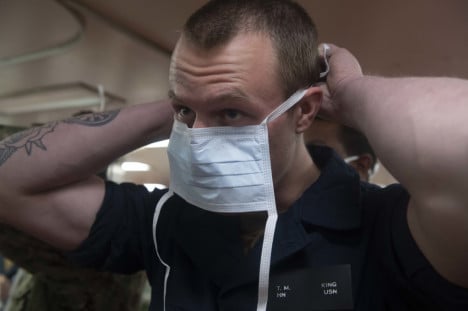
It is recommended to wash your hands well before installing any type of protective mask, thus you will limit the preliminary contamination of the filters or the mask itself, especially if you are in an already dusty or contaminated environment.
Then, the mask must be perfectly sealed to your face, whether it's a half mask surgical type, FFP or filter type. Same thing for the full mask, it must not allow air circulation. The only entry must be through the filters located at your mouth level.
Once your filters are installed and your mask hermetically fixed, you are ready to work in good conditions.
Of course, respiratory protection masks are not the only personal protective equipment to use. Make sure to inform yourself and equip yourself properly to run the least possible risks. VET SÉCURITÉ offers all types of PPE for all areas of activity



-
![Over 200 brands At the best price]() Over 200 brands At the best price
Over 200 brands At the best price -
![Secure payment In 3 or 4 interest-free installments]() Secure payment In 3 or 4 interest-free installments
Secure payment In 3 or 4 interest-free installments -
![Delivery across Europe From €79 of purchase]() Delivery across Europe From €79 of purchase
Delivery across Europe From €79 of purchase -
![Customer service Monday to Friday]() Customer service Monday to Friday
Customer service Monday to Friday


