The best equipment for pros and enthusiasts alike



 Professions
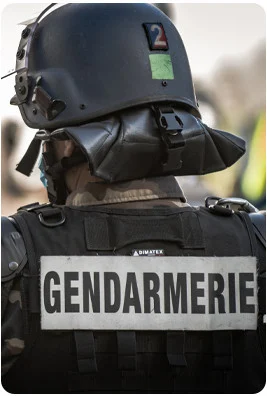
The National Gendarmerie Intervention Group (GIGN) is the elite unit of the French National Gendarmerie. It is renowned for its efficiency and courage in the most perilous missions. Its identity is rich in history, strong symbols, and imbued with republican values. The GIGN doesn't only fascinate within French territory. Its influence extends well beyond our borders and its motto "Commit for life" ("Save lives at the expense of one's own" until 2014) is not an empty phrase but a calling.
Table of Contents:
- The birth of GIGN: the legacy of Munich (1972)
- The GIGN's feats of arms: exceptional missions in service of France
- An identity rich in symbols: the founding values of the GIGN
- Royal honors: the crowning of 50 years of history
- GIGN: between heritage and innovation
The GIGN traces its origins to tragic events and the need to constitute an intervention unit capable of intervening in crisis situations. The Gendarmerie, among the first, proposes to establish a "commando intended to fight against air piracy, made up of trained athletic elements and whose intervention could be requested throughout the national territory" (source: https://www.gendarmerie.interieur.gouv.fr/gign/histoire-et-traditions/historique-du-gign).
Indeed, one event in particular will contribute to its creation. 1972, Munich Summer Olympics. On September 5, 8 members of the Palestinian group Black September take hostage, in the early morning, 9 people from the Israeli delegation. The total toll amounts to 17 dead, including 11 Israeli athletes. The assessment is grave. We'll note the lack of preparation (the security of the Olympic village is virtually non-existent), lack of available equipment (armored vehicles posted 30 minutes from the airport where the action has moved, no radio contact between the posted snipers who have neither bulletproof vests, nor scopes, nor night vision equipment, etc.). Moreover, said snipers have just been recruited from surrounding shooting ranges.
This dramatic episode leaves the 1972 Olympics in mourning and marks a decisive turning point in governments' reflection surrounding crisis management. To avoid reliving such a day, it is agreed that specific means must be implemented.
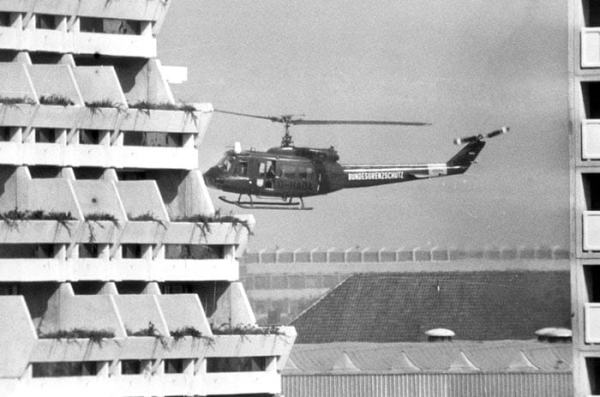
Olympics 2012 Photos https://sports.ndtv.com/
The response provided by France is the creation of units dedicated to this type of threat. Among these units, GIGN 1, based in Maisons-Alfort and GIGN 4, located in Mont-de-Marsan, were established in 1974. Two years later, they were first reunited in Maisons-Alfort. Then, in 1983, the 2 entities were transferred to the current headquarters of the unit in Satory (Versailles).
The Group will undergo various restructurings until September 2007, which corresponds to what is called "the second generation". The unit then combines the skills and missions of the 1974 GIGN, the EPIGN (National Gendarmerie Parachute Intervention Squadron), the GSPR (Presidential Security Group) and the GISA (Activities Security and Instruction Group).
Since its creation, the elite unit has to its credit numerous missions that have marked the history of France on national territory and beyond its borders, some more well-known than others:
- February 3, 1976, Djibouti: armed independence fighters from the Somali Coast Liberation Front take hostage a school bus carrying 31 children of French military personnel. On February 4, 9 GIGN snipers commanded by Lieutenant Christian Prouteau set up their equipment 180 meters from the bus. At 3:45 PM, these men use, for the first time, "simultaneous fire" and kill 5 hostage-takers. At 4:05 PM, the mission is accomplished. The toll remains heavy with notably 2 girls killed and 5 children wounded, but the commitment of these men, who save that day 29 French children, is one of the first significant events for the unit.
- November 20, 1979, Mecca: 200 Islamic fundamentalists (Saudis and Egyptians) take hostage the 50,000 faithful inside the Grand Mosque. Three gendarmes from Christian Prouteau's team (Warrant Officer Christian Lambert, Warrant Officer Ignace Wodecki and Captain Paul Barril) are sent by France under Valéry Giscard d'Estaing to assist Saudi forces. They contribute to the liberation of the holy site notably thanks to spraying the mosque and its underground areas with non-lethal gases after 54 hours of negotiations.
- December 26, 1994, Marignane: this is certainly the most symbolic mission. The one that will make GIGN, in the eyes of the world, a unit of excellence. The operation takes place at Marseille-Provence airport during the refueling stop of Air France flight 8969. It all begins on December 24 in Algiers when 4 members of the GIA (Armed Islamic Group) take hostage the approximately 200 passengers of an Airbus A300 flying from Algiers to Paris. 48 hours later, the aircraft lands in Marignane where Denis Favier's men are already stationed. At the end of the day, thanks to motorized gangways, the assault is launched. 20 minutes later, the last hostage-taker is neutralized. Less than thirty people are injured. According to Denis Favier's words, "Operation completed, limited losses".
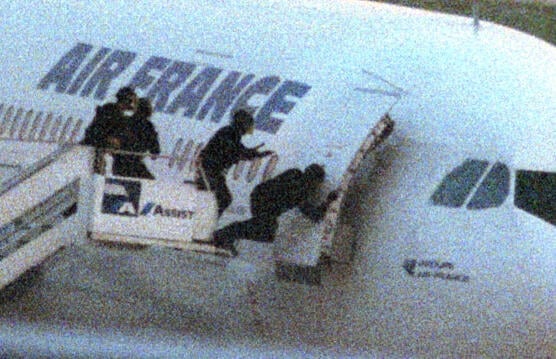
GIGN assault on December 26, 1994, Marseille-Marignane airport ERIC CAMOIN/REUTERS
The unit also distinguished itself in May 1974 during the Fleury-Mérogis prison mutiny, in 1988 during the Ouvéa hostage crisis, and on numerous aircraft hijackings, control of entrenched gunmen, and hostage releases concerning publicly disclosed operations. Over the last 10 years, notable operations include the hunt for the Kouachi brothers (2015), those of Frédéric Cuvelier in the Cévennes, Terry Dupin in Dordogne or the one in Gréolières in 2021, the securing of riots in New Caledonia (2024) and more recently the Olympic and Paralympic Games in Paris (2024).
The Group is defined above all by its values. They define its identity as much as the way it operates during missions. If we had to remember the most important ones:
- The cohesion and team spirit that are cultivated from recruitment and take precedence over individuality
- Trust in one's teammates to be able to function as a united entity
- Courage for which "the weapon must not be a substitute" (words of Christian Prouteau)
- Resilience and unwavering commitment up to the ultimate sacrifice if necessary
- Excellence that drives them to constant training, rigor, and permanent discipline
- The sense of duty and love for the flag
- Integrity but also ethics. These men and women must have exemplary behavior and act in respect of laws and human rights. Respect for human life is at the heart of the unit's action and the use of weapons is always the last option.
You may one day hear "We serve the GI, we don't use the GI for our own benefit". The entity is greater than the individual. Its reputation must be preserved and protected.
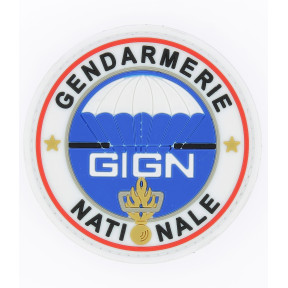
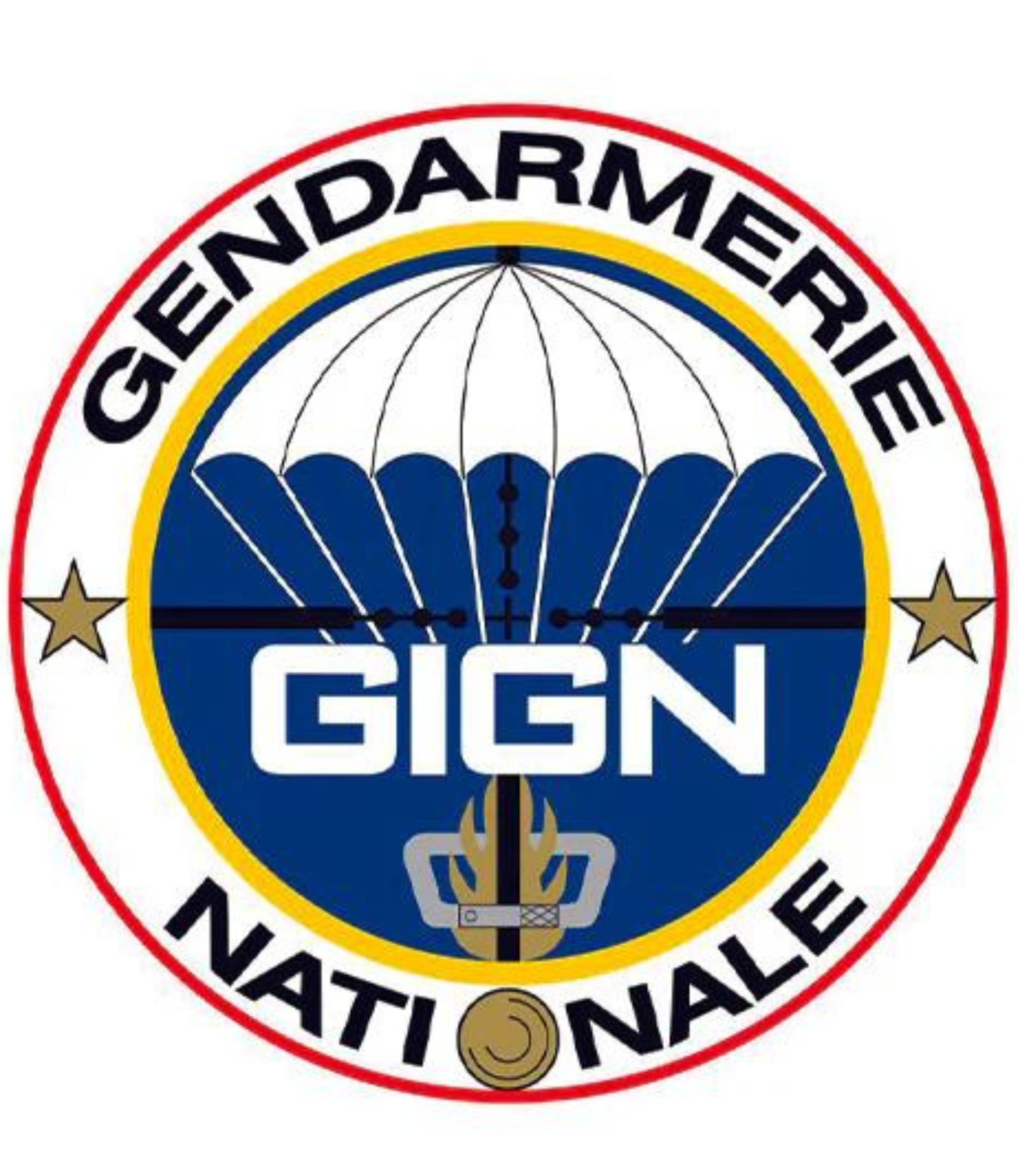
The Group is recognizable by its roundel emanating from the historical merger of September 1, 2007 (mentioned above). It represents the skills and values of the Group:
- The circles present on the shield are meant to represent the united group formed by its men and women and their ability to work cohesively in all types of crises. They also recall the numbered badge received by each operative upon completion of their training. It's the mark of their integration into the unit.
- The blue background of the badge evokes the group's underwater capabilities and its unit of intervention divers.
- The parachute, next, recalls the GIGN's membership in airborne troops and the protection of Saint Michael, the unit's patron saint. Moreover, it's a nod to the operational parachutists cell.
- The sight reticle evokes shooting, precision, and mastery in every action, particularly during the trust shot which emphasizes the training of recruits. It also embodies respect for human life in missions.
- The stars on either side of the circle signify "second generation", the one that emerged in 2007.
- The carabiner is the symbol of crossing techniques, skills in air rope work. It illustrates the versatility and adaptability of GIGN operatives.
- The grenade, finally, has been the emblem of the National Gendarmerie since 1971. It is a sign of prestige, especially that of the "grenadiers" who were an elite military troop.
This year, the GIGN celebrated its 50th anniversary. In front of carefully selected guests composed, among others, of high authorities and former personnel, the stamp created for the occasion bearing the unit's effigy was unveiled. The military ceremony that followed was punctuated by honors and the presentation of a medal to the unit's flag, which was already decorated with two crosses of military valor, a medal of internal security and now the medal of honor for foreign affairs for acts of bravery and devotion. This was followed by a review of the troops and the decoration of several military personnel individually.

https://www.laposte.fr/
During the solemn ceremony, Christian Rodriguez, Army General and Director General of the National Gendarmerie paid tribute to him in these terms: "These four letters [which] embody excellence in service of France and the French. (…) The GIGN has always been the recourse in the face of the most critical situations, the most violent threats. (…) In service, you are, of protecting populations as well as preserving the highest interests of the Nation (…)"
He also mentioned "All these discreet successes, these commitments that you only discuss among yourselves, to express their demands and complexity" in order to remind and commend the duty of discretion that all operatives of this force must respect.
He finally expressed his admiration to them: "For 50 years, the GIGN has been above all the military personnel who comprise it. (...) These women and men united by a merciless selection, uncompromising training, and above all a proven and inflexible will, that of committing oneself for others, that of serving. In operation as in training, you give your requirement only one objective: excellence. That of the perfect mastery of your technical and tactical skills, that of your rare specialties, that of your collective power. (…) Men and women who make up the GIGN today, as for 50 years, you are the honor of your unit, the honor of the gendarmerie and the honor of France. (…)"
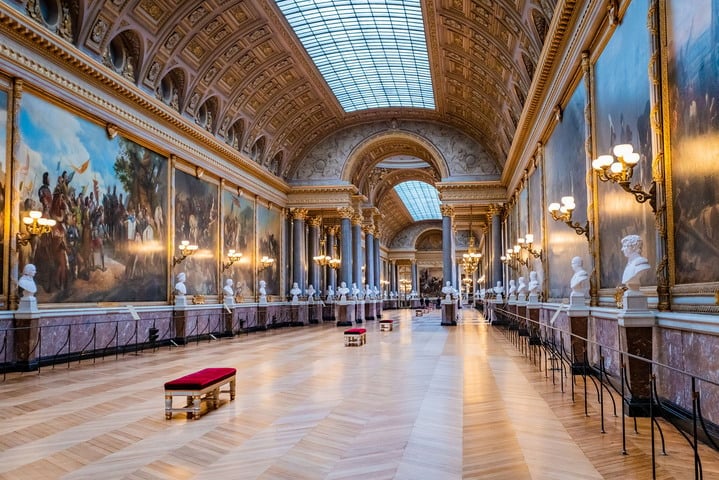
The day concluded with an evening organized in the majestic setting of the Palace of Versailles. A lavish conclusion for a unit that continually promotes Versailles throughout the world.
https://www.futura-sciences.com/
The National Gendarmerie Intervention Group is above all an institution whose foundations are based on strong values. Its history is paved with significant and sometimes tragic events that have shaped its purpose. Its successive reorganizations, some very recent, demonstrate a perpetual desire to evolve to face new threats such as mass hostage-taking (MHT) like the one in Beslan (September 2004) or the so-called "low-cost" terrorism that led to the integration of branches in 2021. This latest restructuring allows for a faster response anywhere in the national territory. The GIGN commanded by Major General Ghislain Réty has not finished making us dream!
Do you want to become one of these operatives? Don't miss the continuation of the GIGN trilogy. You will learn everything (or almost everything) about the different components of the Group and the trials to join it.