The best equipment for pros and enthusiasts alike





-45%
 Professions
The year 2022 sees the safety shoe standard EN 20345 evolve. Gradually, all new models will be certified according to the EN ISO 20345: 2022 standard instead of the EN ISO 20345: 2012 standard. This change should allow the introduction of several significant developments, particularly regarding requirement levels for puncture resistance. Manufacturers have the right, throughout 2022, to still use the old standard, but the transition must be completed within the next 5 years, before shoe models using the old certification are no longer compliant with the standard now in force.
Summary:
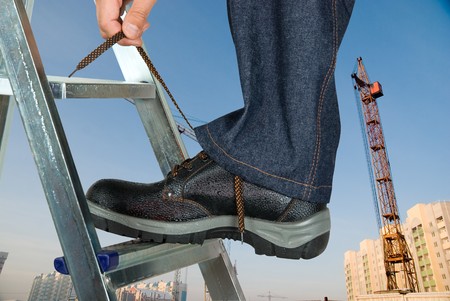
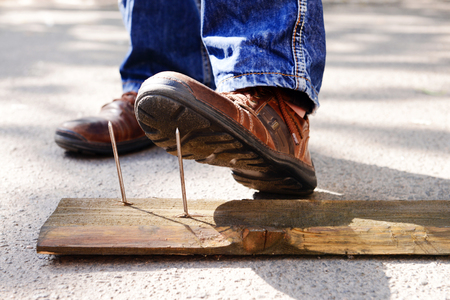
Until now, the P marking encompassed all tests performed on anti-puncture plates, whether they were metallic, textile or composite material. From now on, it only concerns metallic anti-puncture plates. For the others, two new additional standards are introduced:
As before, the additional P standard (anti-puncture) is automatically included in the certification of S3 safety shoes. But it will now be necessary to distinguish S3S shoes (PS marking) from S3L shoes (PL marking), according to the type of point used for the test. The requirement level being higher for fine points (PS), this implies reinforcing anti-puncture soles with textile or composite plates that are heavier, denser and less flexible.
Generally speaking, if neither marking (S or L) is indicated, it means these are S1P shoes or S3 tested on metallic anti-puncture plates.
The new standard implemented from 2022 sees the disappearance of the following 3 markings, usually used to evaluate a non-slip sole:
Old markings (abandoned):
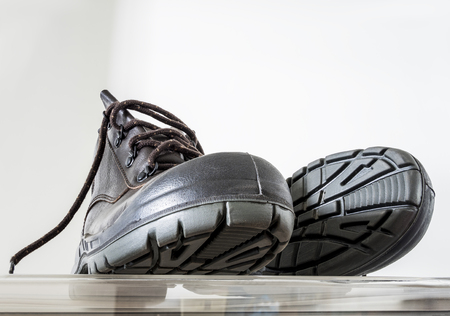
To meet the basic requirement [SB], all safety shoes will have to pass a slip resistance test on tiled floors with detergent (lauryl sulfate), which corresponded to the SRA level. Too rarely encountered, the SRB marking concerning steel and oily floors is abandoned in favor of a new additional SR marking. The difference between the two is that the SR marking test will indeed be used with oil, but on a tiled floor.
Basic requirements [SB]:
Additional requirement:
This point mainly concerns professionals faced with an environment containing hydrocarbons. Indeed, the FO standard becomes additional and will no longer be required by default for safety shoes. A sole certified [FO] does not exceed 12% volume increase when it comes into contact with hydrocarbons.
Additional requirement:
In order to see more clearly the real effectiveness of toe guards, the new standard adds the optional SC marking. A pair of shoes can obtain this marking for stone guard toe caps if they achieve sufficient abrasion resistance. The second addition concerns dropped heels which, if they reach a certain size, can claim the LG requirement.

To better highlight the waterproofing properties on all shoes (WR), or only on the upper (WRU), the S6 and S7 markings are introduced.
In practice, this will make it possible to distinguish between S3 shoes that are only WRU, S7 shoes that are WRU with a WR membrane, or S3 WR shoes (with a WR membrane but without WRU properties). Eventually, the use of WRU marking will be renamed WPA.