The best equipment for pros and enthusiasts alike




 Professions
Choosing a holster is an important decision for any professional in law enforcement, military, or even for sport shooting enthusiasts. A well-adapted holster guarantees not only the user's safety, but also their comfort and operational efficiency. This guide aims to help you understand the different types of existing holsters, their distinctive characteristics, and the criteria to consider in making an informed choice.
Summary:
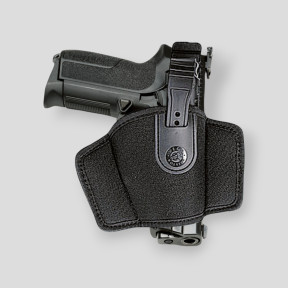
In the specialized lexicon of law enforcement, the Anglo-Saxon term "holster" is often used to designate what is commonly called a case. Contrary to popular belief, the holster is not reduced to a simple soft case worn under the shoulder. It is above all a device intended to hold a handgun in a secure manner while allowing rapid access when needed. Historically, we spoke of revolver case, then pistol case in the army, thus marking the importance of this device as an accessory inseparable from the weapon. In short, the holster is an essential element for police officers, gendarmes and military personnel, and must combine protection, security, comfort, and compatibility with other operational equipment.
.jpeg)
The choice of holster relies on two crucial factors: the intended mission and the weapon used. Each holster has distinct characteristics that make it more or less suited to different operational situations. Since there is no universal holster that can suit all situations, it is essential to carefully evaluate the specific needs of each mission, in terms of prevention, investigation or defense.
The compatibility of the holster with the weapon is also fundamental. Although certain so-called universal holsters can adapt to various weapon models, a non-specific holster can create risks, such as difficulty of access or restricted movements, which become potentially dangerous in emergency situations. An ill-fitted holster can not only cause discomfort, but also compromise the operator's safety.
The choice between concealed or open carry of the holster depends closely on the nature of the mission and the operational framework. In civilian clothes, concealed carry is often preferable to guarantee discretion and efficiency, while in uniform, open carry is generally required.
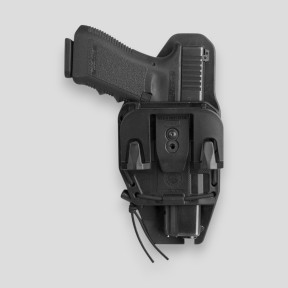
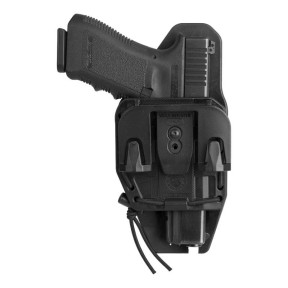
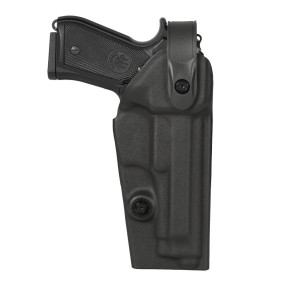
Open carry holsters, often attached to the belt or worn on the thigh with a tactical plate, offer direct and rapid access, crucial for certain interventions. On the other hand, concealed holsters, such as "inside" (IWB) models, allow the weapon to be concealed under civilian clothing, offering better discretion. Since 2015, police officers can legally carry their weapon off duty, hence an increased need for discreet holster models combining comfort and security.
Here is an example of different types of carry:
Thigh holster: Used when the operator is in a seated position (in a vehicle, for example) or when low carry is required, such as with a protective vest.
Shoulder holster: Worn under the shoulder, offering quick access under a jacket. This type is particularly suited to situations requiring maximum concealment.
Ankle holster: Perfect for a backup weapon, although it has limitations in terms of speed of access.
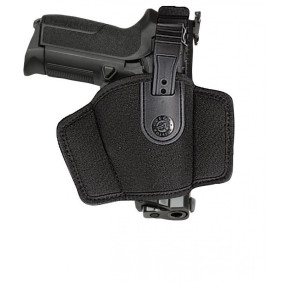
Belt holster: Discreet solution, widely used by law enforcement in civilian clothing, offering comfort and integration of other accessories.
The composition of the holster directly influences its functional properties: durability, comfort, security, and ease of maintenance. The materials used must therefore be chosen according to the conditions of use and the specific needs of the user.
Leather: Long the reference material, leather remains prized for its aesthetics, its durability, and its ability to conform to the shape of the weapon. Ideal for concealed carry, it nevertheless requires regular maintenance to maintain its mechanical properties.
Polymer: Light, robust and adaptable, polymer allows the design of holsters equipped with sophisticated retention systems. It is particularly appreciated for missions requiring open carry due to its rigidity and its ability to protect the weapon against impacts.
Kydex: Thermoformed material that combines lightness, weather resistance, and malleability. Often preferred for discreet IWB (Inside the Waistband) holsters, Kydex is less comfortable than leather, but offers better abrasion resistance and requires no special maintenance.
Nylon: Used in so-called universal holsters, nylon offers a good combination of lightness, comfort and durability. Although it is less rigid than polymer, it remains a popular option for less specific applications.

Weapon retention is a major security criterion that relies on two main systems: passive retention and active retention.
Passive retention: This type relies on friction between the holster and the weapon. Although it allows for quick drawing, it presents an increased risk of snatching by a third party. The simplicity of this system nevertheless makes it suitable for low-risk contexts where speed of access takes priority.
Active retention: Additional mechanisms, such as trigger guard locks, provide greater weapon security. Drawing requires an additional specific action, which reduces the risk of disarming by a third party. This type of retention is commonly adopted by law enforcement in high-risk environments.
Holsters are often classified according to retention levels ranging from 1 to 3, allowing to quantify the security offered.
Level 1 (passive retention): This level offers moderate retention, often based on friction. It is sufficient for routine low-risk missions, where speed of access is essential.
Level 2 (simple retention): Incorporates an active mechanism, for example pressure on a lock, guaranteeing more secure retention. This level is ideal for law enforcement operating in urban environments or in moderate-risk contexts.
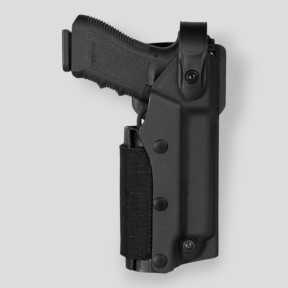
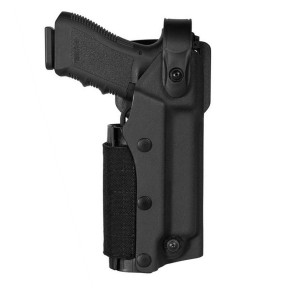
Level 3 (double retention) : Offering maximum security, this level includes several locking mechanisms, such as an additional security hood. It is recommended for operations in particularly hostile environments, where protection against theft or loss of the weapon is paramount.
Choosing a holster is a complex decision that must take into account various criteria, including the nature of the mission, the weapon used, and the specific comfort and security needs. For security professionals, military personnel, or even sport shooters, it is imperative to select a holster that ensures not only compatibility with the weapon, but also a level of security appropriate to field requirements. The manufacturing material, the type of carry, and the retention level are determining elements that will contribute to maximizing the user's efficiency and safety in often critical situations. A suitable holster does not merely carry a weapon; it becomes an essential extension of the operator, contributing to their safety and operational effectiveness.