The best equipment for pros and enthusiasts alike
 Professions




Effective camouflage does not make you invisible. It delays identification. A few seconds gained can be enough to change the outcome of an observation, an advance, or a tactical action.
Military camouflage pursues an apparently simple objective: making a soldier, vehicle, or piece of equipment harder to spot. But behind this obvious goal lies an exacting discipline, at the crossroads of visual biology, perception psychology, and materials science. Since the First World War — which marked a genuine explosion of experimentation in this area — camouflage has continually evolved to meet ever more sophisticated threats.
In this guide, we review the main pattern families, the visual techniques used by modern armies, and the concrete criteria for choosing the right camouflage based on your terrain and intended use — whether for military service, reserves, airsoft, or outdoor activities.
The fundamental principle
The human eye naturally detects certain cues: a head, shoulders, an artificial straight line, a movement, a color that stands out from the environment. Good camouflage acts simultaneously on several levels to disrupt this instinctive reading.
The pattern reproduces the dominant tones of the terrain: green, brown, sand, gray, beige, or white depending on the context.
Contrasting shapes break up the human outline: this is one of the most critical principles of so-called disruptive camouflage.
Avoid overly visible breaks between the wearer and their immediate background, by playing on intermediate tones.
Imitate or evoke foliage, shadows, rocks, dry grass, or concrete depending on the targeted biome.
A pattern effective at 100 meters may be counterproductive at 5 meters, or vice versa.
The main pattern families
Each environment calls for its own chromatic codes and its own disruption techniques. The six families below cover the essential terrains and uses.
Woodland / Forest
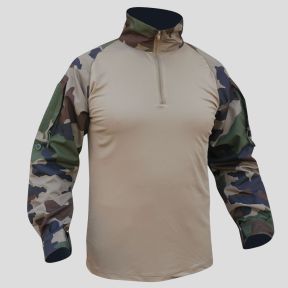
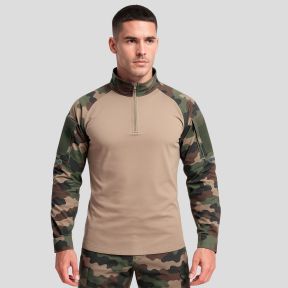
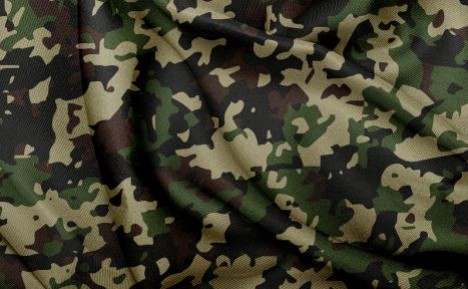
M81, DPM, French CE. Green, brown, black, beige. Ideal in temperate undergrowth.
Desert
Sand, ochre, tan tones. Less dark: shadows are rare in arid zones.
Arctic / Snow
Off-white + gray traces. Pure white is not always optimal in real snow.
Urban
Gray, black, concrete. Designed for structures, ruins, and asphalt.
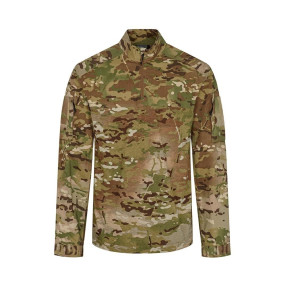
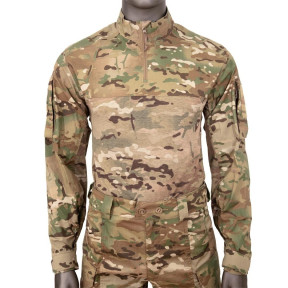
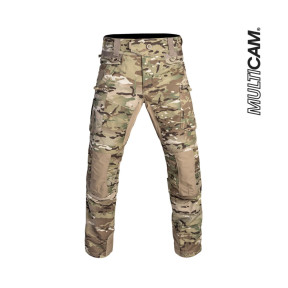
MultiCam / OCP
The modern compromise: mixed greens, browns, and beiges. Versatile since the 2000s.
Flecktarn
"Fleck" = spot. Dense small German spots. Very effective in European forests.
Advanced visual techniques
Mimicry
The most obvious principle: the pattern visually reproduces the environment. A forest camouflage will imitate leaves, shadows, and trunks. It works best in homogeneous settings. As soon as the terrain changes, its limitations appear quickly.
Multi-distance visual confusion
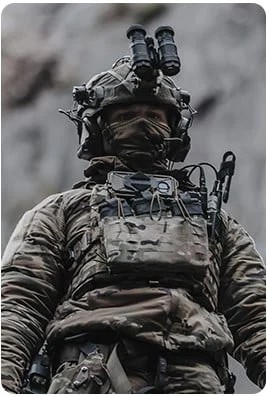
Modern hybrid patterns play on multiple scales simultaneously: at close range, they create texture; at medium range, they break up the silhouette; at long range, they blend into the general tone of the terrain. This is the founding principle of camouflage patterns such as MultiCam and OCP.
Digital vs. organic camouflage patterns
Digital patterns such as MARPAT or CADPAT use pixels and square shapes to blur outlines at various distances. Organic patterns such as Woodland, Flecktarn, or DPM favor rounded, natural shapes. Note: digital does not automatically mean superior.
Choosing your camouflage by environment
The number one criterion remains the dominant color of your operational terrain. Season, lighting, vegetation density, and observation distance then refine the choice.
| Terrain | Recommended patterns | Key colors |
|---|---|---|
| Temperate forest | Woodland Flecktarn DPM French CE | Olive green, brown, black |
| Dry / rocky terrain | MultiCam OCP Arid | Beige, tan, stone gray |
| Desert | Desert 3 colors MultiCam Arid | Sand, ochre, light brown |
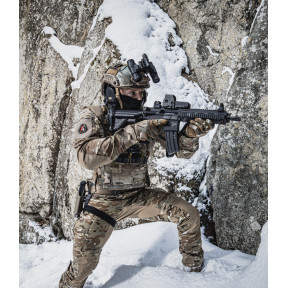
| Mountain | MultiCam OCP Specific rocky terrain | Gray, dull green, beige ± white |
| Snow / Arctic | Snow camo White oversuit | White, light gray, soft black |
| Urban | Urban camo Digital gray | Gray, black, concrete, blue-gray |
Beyond the fabric: the complete silhouette
Camouflage is never solely a matter of clothing. The overall silhouette is what the adversary perceives first. Every element worn contributes — or detracts — from overall concealment.
The most visible and most neglected areas. Camouflage paint, balaclava, neck gaiter, and gloves reinforce visual consistency.
Backpack, tactical vest, MOLLE pouches, holster. A shiny black bag can ruin an otherwise well-chosen outfit.
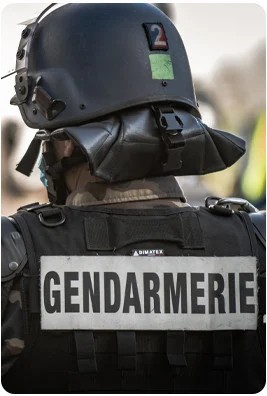
Black or shiny equipment stands out sharply in a natural environment. Chromatic consistency extends to every element worn.
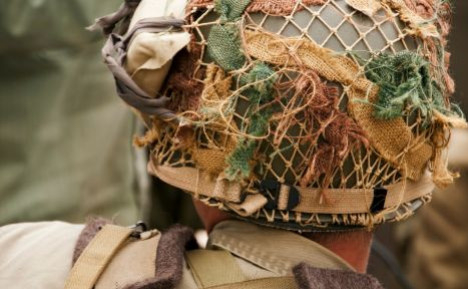
3D camouflage taken to the extreme. It almost completely breaks up the human silhouette through synthetic fibers, jute, and integrated local vegetation. Read our article: everything you need to know about the ghillie suit.
Movement is the worst enemy of camouflage. The human eye detects motion faster than color or shape. Even the best pattern becomes ineffective against a sudden advance in open terrain.
Common mistakes to avoid
Woodland in an arid zone, urban in dense forest: these mistakes turn an asset into a visible handicap.
CE pants, MultiCam jacket, black bag: a confused silhouette is not necessarily a discreet silhouette.
A chrome watch, metal buckle, reflections on an optic: every point of shine can betray a position.
The human face is one of the shapes most readily recognized by the brain. Without chromatic protection, even the best-chosen outfit remains incomplete.
A popular or aesthetically pleasing pattern is not necessarily functional for the intended terrain. Fashion never takes precedence over operational effectiveness.
Camouflage in the age of modern sensors
Today, camouflage is no longer solely about the human eye. Modern armies must contend with detection by night vision, infrared, thermal imaging, drones, and multispectral sensors. This evolution drives a logic of so-called multispectral camouflage: special fabrics and treatments designed to reduce the signature across spectra well beyond the visible range.
The pattern printed on the fabric is just one component among others in a global concealment system. Military equipment manufacturers are working on materials that reduce infrared and thermal emissions, making uniforms more effective against night vision devices and reconnaissance drones.
Perfect camouflage does not exist
There is the right camouflage, chosen for the right terrain, worn the right way, complemented by the right accessories — and applied with discipline. It is this consistency that makes the difference in the field.