The best equipment for pros and enthusiasts alike







 Professions
The rise of Virtual Reality (VR) and Augmented Reality (AR) is transforming many fields, including that of law enforcement. These immersive technologies offer unprecedented possibilities for training, intervention and investigation, paving the way for more effective and secure methods.
While virtual reality allows for the recreation of complete environments for training and simulations, augmented reality provides powerful tools for crime analysis and resolution by overlaying virtual elements onto the real world. Let's explore how these technological advances are revolutionizing law enforcement practices.
Summary:
Augmented reality is a digital technique that allows the integration of virtual 3D elements into the surrounding field of vision. The principle is to combine the virtual and real to give the user the illusion of perfect integration. Unlike virtual reality, which completely replaces our environment, augmented reality enriches it with additional information and elements. This technology has potential applications in many fields, such as cinema, aviation and medicine. In the judicial field, the use of AR is beginning to develop, although it is still in the experimental phase.
Within the Criminal Research Institute of the National Gendarmerie (IRCGN), the Signal Image and Speech (SIP) department explores and develops innovative augmented reality (AR) applications, a promising technology in the forensic field. Currently operational at IRCGN, AR allows 3D modeling of objects such as weapons or bodies, which can be visualized at a crime scene using smartphone, glasses or tablet applications.
The SIP department is also working on complementary modules to enhance current AR applications, with innovations planned to be available within two to three years. These advances pave the way for more interactive and immersive methods, where augmented reality offers concrete solutions to overcome the technical and logistical challenges of modern criminal investigations.
By continuously integrating new features, the SIP department ensures that the developed tools remain at the cutting edge of technology, meeting the evolving needs of field experts and guaranteeing increasingly precise and efficient methods.
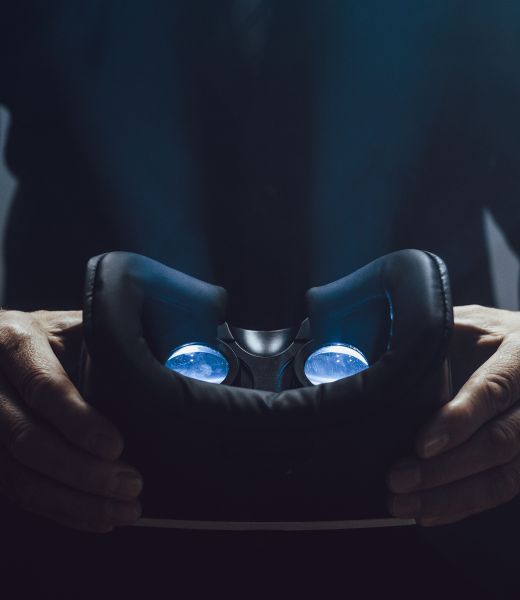
Virtual reality (VR) creates a completely artificial environment in which users can interact immersively, opening new perspectives in the training and education of law enforcement and military personnel. By immersing users in realistic virtual scenarios, VR offers an incomparable learning experience.
Virtual training scenarios allow users to develop their technical and tactical skills, improve their decision-making under pressure and strengthen their team coordination. One of the main advantages of VR is the ability to repeat scenarios as many times as necessary. VR also allows detailed analysis of user performance. Each training session can be recorded and reviewed to identify strengths and areas for improvement.
The future of virtual reality in training and education looks promising, with continuous developments that will achieve even higher levels of immersion and realism.
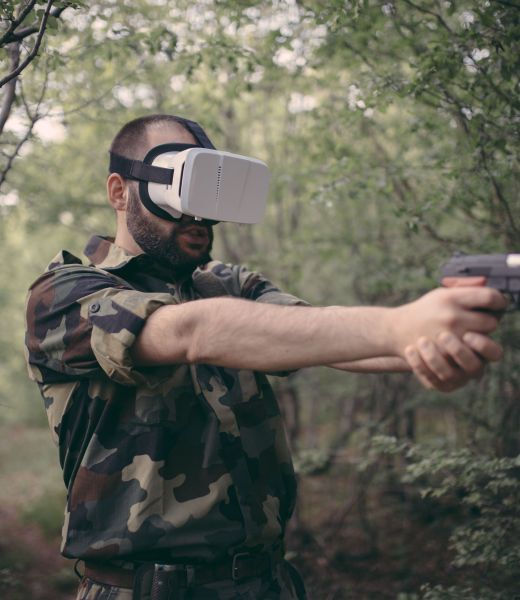
Precise crime scene modeling: AR allows for 3D reconstruction of crime scenes or accidents, providing an immersive and detailed view from all angles. This capability helps detect crucial evidence often invisible to the naked eye during traditional inspection.
Real-time assistance: Thanks to devices such as AR headsets, gendarmes can receive real-time instructions from remote experts, thus optimizing field sampling and analysis.
Effective presentation during trials: AR facilitates the presentation of bulky or immovable objects by recreating them virtually. This reinforces the parties' arguments through concrete visual demonstrations.
Realistic and safe training: AR simulators allow law enforcement to train in realistic environments without risk, improving their preparation for dangerous situations.
Simulation of dangerous environments: VR allows recreation of combat situations or dangerous interventions, providing immersive and realistic training without risk of injury.
Weapon and equipment handling: VR allows testing and training in weapon handling with haptic feedback, faithfully recreating the recoil and weapon experience.
Medical training: VR simulations for complex medical procedures allow healthcare professionals to train in stressful conditions without risk to patients.
Vehicle simulation: VR flight and driving simulators allow users to train in a secure environment, improving their preparation and safety.
Augmented Reality (AR)
Privacy issues: AR collects biometric and behavioral data, raising concerns about the confidentiality of sensitive information.
Cost and accessibility: The development and implementation of AR technologies can be expensive, limiting their accessibility for certain units or services.
Technological dependence: Increased dependence on AR technology can pose problems in case of technical malfunction or cyberattacks.
Virtual Reality (VR)
Sensitive data collection: VR collects detailed biometric data, such as eye movement and gesture tracking, which can be exploited in case of data breaches.
Cyberattack risks: VR platforms can be targeted by ransomware or cybercriminals, endangering personal information and user security.
Anonymization difficulty: VR tracking data is difficult to anonymize due to unique movement patterns, making users vulnerable to identification.
Health problems: Prolonged use of VR can cause side effects such as eye strain, headaches and nausea, impacting user performance.

Proof of law enforcement's interest in the metaverse, in March 2022, the United Arab Emirates and France organized the first international virtual security exercise in this digital universe. Members of the French Police and National Gendarmerie participated in this event, virtually bringing together nine countries from the International Security Alliance (ISA). Named ISALEX 2.0, this world first allowed 50 security experts to collaborate for three days in the metaverse, working on cybercrime and drone attack scenarios.
This was an opportunity to test cooperation and collaborative work by bringing teams together in virtual operations rooms. According to Hamad Khatir, director of the international operations department at the UAE Ministry of Interior, this exercise demonstrates the importance of practical experience in a virtual reality environment to support real-time police training, facilitate knowledge sharing and stimulate international cooperation. "Today, we are bringing law enforcement into the metaverse, but it's ultimately in the real world that we will reap the benefits", he declared.
The National Gendarmerie, having participated in this unprecedented exercise, shows growing interest in the metaverse. It publishes the Cultur'IA review, dedicated to artificial intelligence and its applications in security, and is already considering ways to exploit these immersive virtual universes. Among possible applications are crime scene analysis via an immersive interface, improved training for intervention and crowd control units, and the implementation of complex scenarios for operational actors without exposing them to real dangers.
In the future, the Gendarmerie plans to use the metaverse to conduct prevention, information and communication actions, and offer better accessibility to its services. Nevertheless, it is aware that an enforcement component will be necessary to deal with delinquency in this virtual environment. The metaverse, although perceived as a distant future, raises many essential questions for security, motivating initiatives like those of Interpol.
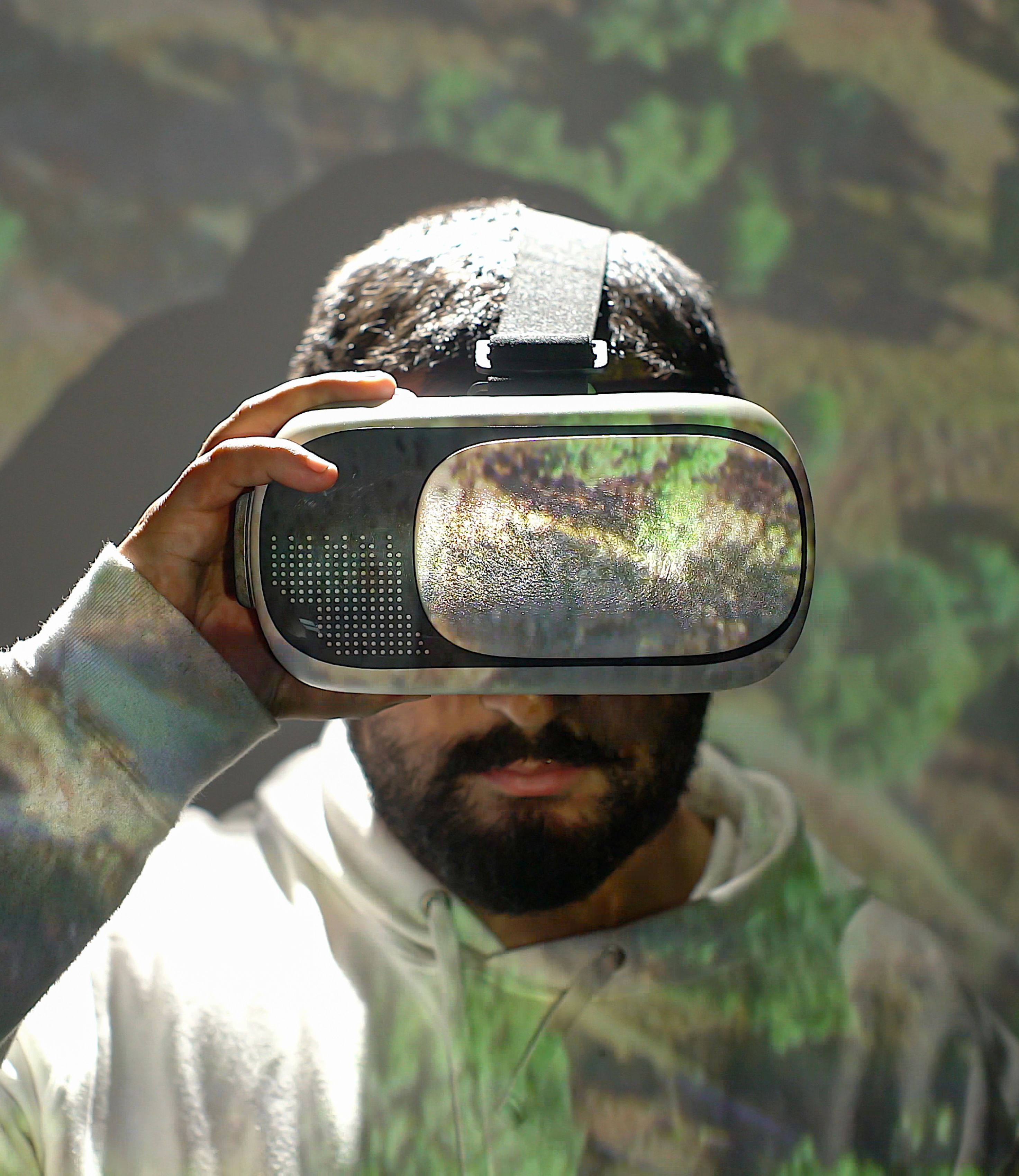
Jürgen Stock, Secretary General of Interpol, affirms "for many, the metaverse is synonymous with a distant future, but the questions it raises are those that have always motivated Interpol: helping our member countries fight crime and making the world, both virtual and real, safer for the populations living in it."
Interpol has therefore created an expert group to ensure metaverse security from its conception and prepare for new threats, such as child exploitation, data theft, money laundering, financial fraud, and many others. In October 2022, Interpol launched the world's first police metaverse, allowing users to virtually visit its headquarters in Lyon. Police officers can interact via avatars and follow immersive training. During this launch, a training session on travel document verification was conducted in the metaverse, followed by practical exercises in a virtual airport, illustrating the impressive potential of this technology for police training and collaboration.
Virtual and augmented reality technologies are revolutionizing law enforcement practices by offering innovative training and intervention methods. While VR is already used for training, AR is beginning to find its place in field operations and judicial processes. These technologies will continue to progress, offering new opportunities to improve the efficiency and safety of law enforcement. By embracing these innovations, security forces can better prepare for the complex challenges of the modern world.