The best equipment for pros and enthusiasts alike







-35%
 Professions
The standards concerning PPE for the eyes are numerous and distinct enough that it's easy to get lost. To help you navigate them, we present them in this article, focusing on the most frequently used ones.
Summary:

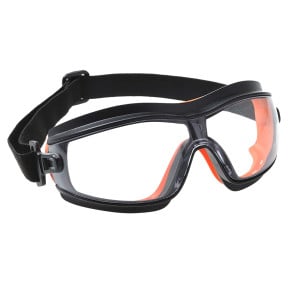
Whatever their nature (glasses, visors, masks, face protection, wire mesh screens...), accessories ensuring individual eye protection are at minimum compliant with standard EN 166. This is the harmonized European official standard for all eye protection and approved in France by AFNOR (French Association for Standardization) as official standard NF EN 166. It does not concern risks related to nuclear radiation, X-rays, laser emissions or infrared radiation emitted by low-temperature sources. A distinction must be made between safety lenses and filtering lenses.

It is the employer's responsibility to provide the employee with PPE adapted to the profession they practice in order to ensure protection of their eyes and face against splash risks from corrosive liquids, against dangerous radiation or against harmful particles suspended in the air. In cases where one already wears prescription glasses, they must be combined with safety glasses with the appropriate level of protection. There are also protective glasses with corrective lenses. Note that other activities such as airsoft also require wearing eye protection to avoid risks related to projectile shots and environmental obstacles, such as branches or thorns for example.

The general standard EN 166 concerning PPE for the eye must specify the mandatory marking of temples and lenses, as well as the level of mechanical resistance which corresponds to impact resistance. The frame and lens must be marked separately, unless they form a whole, in which case the marking will be affixed to the frame. The manufacturer's identification, the filter protection level and the optical class (from 1 to 3 for continuous, intermittent or occasional work) must also be mentioned.

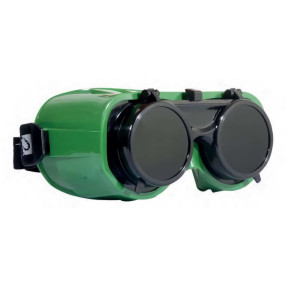
Certain professions are particularly exposed to chemical, mechanical, thermal risks or to radiation (laser, infrared, ultraviolet). There are even PPE for the eye specific to certain trades, such as welding glasses or forestry helmets. The standard EN 169 specifically concerns filters for welding and related techniques. The standard EN 170 groups together eye PPE with ultraviolet filters, while infrared radiation is specified by standard EN 171. As for solar protection filters for industrial use, they are grouped under standard EN 172 and effectively protect eyes against bright lights. Brands such as Uvex, Bollé, Delta Plus, Coverguard, Carhartt or even Portwest specialize in this type of individual eye protection.
STANDARDS:

Unlike the standard EN 169, the standard EN 175 designates protective equipment for the eyes as well as the face for welding, cutting, and related techniques. It must take into account radiation, flammability, as well as mechanical and electrical risks. However, it should be distinguished from standard EN 379 for welding filters with variable protection level or dual protection level. This standard was replaced in 2009 by standard EN 379+A1 for automatic welding filters (or welding filters with switchable shade number). They are used in PPE for the eye for welders or are attached to equipment. Visors, helmets and wire mesh face shields are characterized by standard EN 1731 and protect both the eye and the entire face. They can be adapted for example to forestry work.
STANDARDS:
The standard EN 1836 dedicated to protection filters against solar radiation for general use was replaced in 2013 by the standard NF EN ISO 12312-1 which applies to all afocal sunglasses (non-corrective) and removable additives designed for protection against solar radiation. It is divided into 5 categories classified from 0 to 4 according to the percentage of light filtered (category 0 does not protect against UV). Finally, note that if you wish to observe an eclipse, you will need to equip yourself with protective glasses compliant with standard NF EN ISO 12312-2.