 The best equipment for pros and enthusiasts alike
-
 Professions
-
-
-
-
-
-
-
-
All Tops
![All Tops]()
-
-
-
All Bottoms
![All Bottoms]()
-
-
-
All Footwear
![All Footwear]()
-
-
-
All Bags
![All Bags]()
-
-
-
All Accessories
![All Accessories]()
-
-
Firefighters accomplish many missions on a daily basis. They must be adaptable, as each one presents specific characteristics. In order to carry them out completely, different equipment is essential and requires the use of a particular vehicle to intervene in the best conditions.
This is why we will present the aerial vehicles most commonly used to learn a little more about the daily life of firefighters.
Summary:
Civil Security Dragon Helicopters
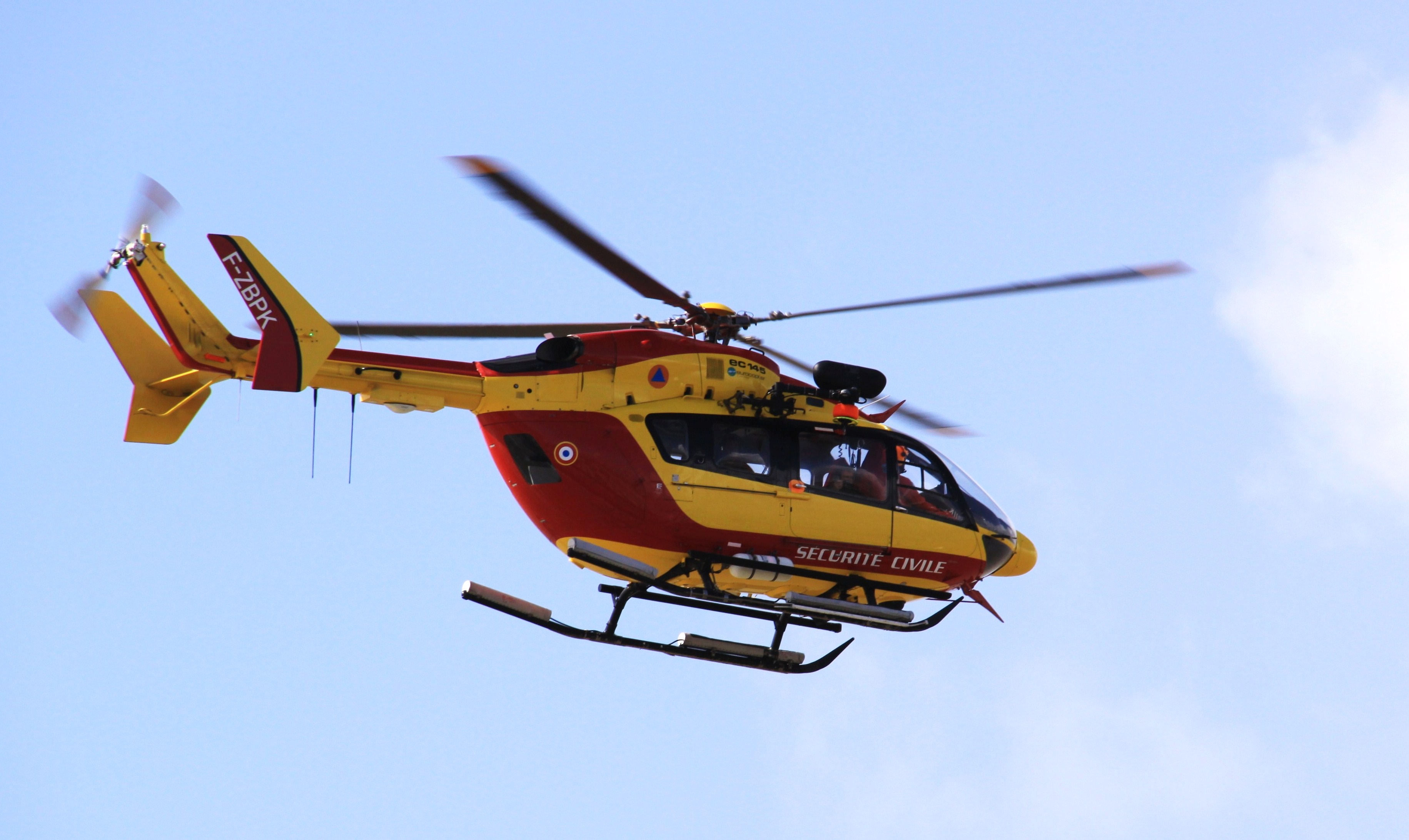
The Dragon helicopters, EC145 model of civil security are available to firefighters, but also to SAMU, police or gendarmerie. They are essentially used to accomplish emergency rescue missions and rescue.
There are about thirty of them in France that have been operating for more than 60 years. They can reach 245 km/h, which allows them to be rapidly mobilized when needed. The crew consists of a pilot and a mechanic operator. The cabin can then accommodate several professionals depending on the intervention to be performed.
Although the Civil Security Dragon helicopters are dedicated to rescue people, they can fulfill technical assistance missions, police or reconnaissance missions on forest fires.
The Bomber Aircraft
Bomber aircraft are essentially mobilized for prevention missions, reconnaissance and forest fire extinction. They intervene in coordination with firefighters mobilized on the ground.
To be more effective during dropping, a product is added to the tanks to stop fire spread more quickly: the retardant.
It is a liquid concentrate that is added to a largely majority dose of water, generally 20% product for 80% water. The retardant is safe for humans, fauna and flora, but remains irritating. This product is red in color, which allows firefighters to spot at first glance the areas that have already received this protective coating and, by contrast, those on which the liquid has not yet been poured. Moreover, it helps reduce flammability by physically blocking the fire, or by triggering a chemical reaction that stops it.
If this product is not exposed to fire, it retains its properties even if the water that makes up 80 to 90% of the product poured has evaporated. Its properties then gradually degrade depending on its exposure to wind and rain.
There are three main bombers, including the canadair, the dash and the tracker that we will present below.
The Canadair
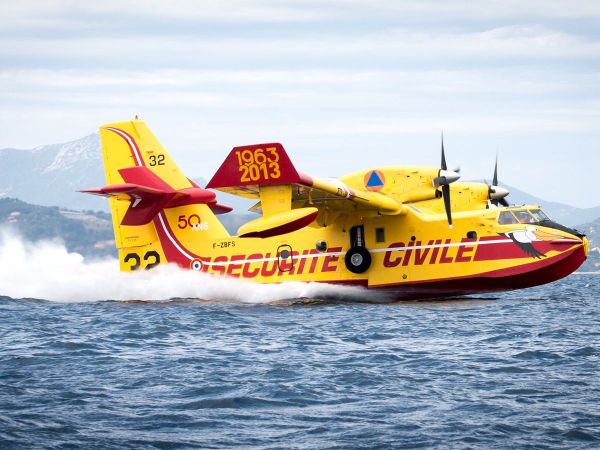
The Canadair is the largest water bomber of the French civil security and has tanks that can contain more than 6,000 liters of water. It can refuel in flight, which constitutes a precious time saving compared to other aircraft forced to return to their air base to resupply. To reload its tanks, the canadair lands on water and can then take off again to go to the intervention site. To perform this resupply, or water scooping, it must skim the surface of a body of water, which can be a lake, river or sea, over a length of about 1,500 meters for an average duration of 12 seconds.
The Dash

The Dash 8 Q400 was initially designed for passenger or equipment transport. It has a 10,000 liter tank, 4 tons more than the Canadair. It offers a high speed of 685 km/h for a range of 2040 km when loaded. It is used to fight vegetation fires. It is a short-haul civil aircraft, developed in the early 1980s capable of carrying 64 people.
The Tracker
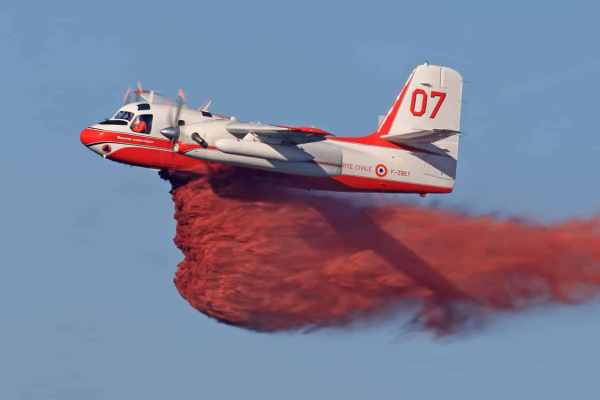
The Tracker was originally a military aircraft, converted into a water bomber in the 1970s. It is used for surveillance missions and first response thanks to its speed that can reach 400 km/h. These aircraft are capable of carrying three tons of water to slow down fire spread.
Aerial reconnaissance modes
The Beechcraft

The Beechcraft 200 super king air is a liaison and reconnaissance aircraft. It ensures in-flight coordination of aerial operations as well as investigation and surveillance missions in high-risk areas and it can also transport professionals to areas that are difficult to access.
The role of the Beechcraft is to establish a situation report and determine the necessary ground and aerial means. It positions itself in orbit in the intervention zone to provide maximum information to firefighters. Occasionally, it may happen that the aircraft in question comes to dive into the fire to verify a particular point.
The orbit generally takes place around 5000 feet or 1500 meters above ground. Such an altitude provides an overview and especially allows the Beechcraft to avoid conflicts with water bombers.
The Drones

Drones can be equipped with radars and cameras, which allow directing and visualizing operations or guiding a rescuer. They have numerous such as spotting a possible fire resumption in forests, searching for a victim in dangerous or aquatic environments, operating in toxic environments, conducting reconnaissance on road accidents or during urban violence.
To pilot a drone, you must hold a pilot's license that you must obtain at one of the examination centers of the DGAC (General Directorate of Civil Aviation).
Related products
Related articles


-
![Over 200 brands At the best price]() Over 200 brands At the best price
Over 200 brands At the best price -
![Secure payment In 3 or 4 interest-free installments]() Secure payment In 3 or 4 interest-free installments
Secure payment In 3 or 4 interest-free installments -
![Delivery across Europe As soon as possible]() Delivery across Europe As soon as possible
Delivery across Europe As soon as possible -
![Customer service Monday to Friday]() Customer service Monday to Friday
Customer service Monday to Friday


