The best equipment for pros and enthusiasts alike






 Professions
Military plates allow armies around the world to identify soldiers' remains on the battlefield. In this comprehensive guide, discover the history, manufacturing, utility, and differences between the American army dog tag and the French military identification plate.
Summary:
The military plate, also called "Dog Tag", or military identification plate, is a small flat piece of metal or plastic worn around the neck by a chain or cord. These plates are used to identify military personnel and have since spread into popular culture. The use of identification plates dates back to the mid-19th century, when soldiers in the Prussian army received aluminum plates to facilitate the identification of their remains on the battlefield.
Today, military identification plates continue to be worn by military personnel from many countries, including France. The purpose of these plates, namely the identification of the body in case of death in combat, remains unchanged regardless of the era or country. Only the materials used and the information engraved on them evolve.
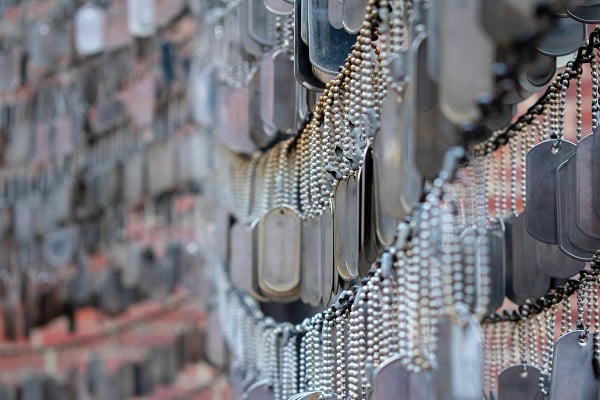
While it was the Prussian army that began using military identification plates, it was the Americans, and notably Hollywood cinema, who made them famous to the general public as a fashion accessory. With personalized engraving, identification plates have also become popular among outdoor enthusiasts (hiking, camping, hunting, etc.) to keep useful information in case of accident or emergency situation.
1862: During the Civil War, soldiers began wearing copper or brass identification plates on which their name, unit, and hometown were engraved.
1906: Official adoption of identification tags for all soldiers.
1916: Appearance of the term "dog tags" due to their resemblance to identification tags worn by dogs.
1940: Stainless steel is introduced as the main material.
1959: Addition of the social security number.
1969: Addition of blood type.
1971: Removal of social security number.
1999: Development of "smart" identity tags equipped with an electronic chip containing the soldier's medical and dental records.
2004: Addition of "silencers" to reduce the noise of identification plates clashing together during combat, notably by adding rubber to the edges.
Today: Military identification plates are no longer called "dog tag", a pejorative term, but "ID tags".
The format of military plates varies by country. American soldiers, for example, have two rectangular identification plates with rounded corners. Each plate contains the same information. Thus duplicated, one of the two plates can be easily detached from the remains to be given to the authorities responsible for the census. The other military plate can be left for the team responsible for recovering the body to facilitate identification. The latter can also be given to the deceased's family.
France did not opt for this two-plate system, but for a single plate system that can be divided in the center into two identical copies. This choice implies staying concise to successfully fit the information on a single plate, in contrast to American military plates which are quite comprehensive.
To read an "Identification Tag", you must start from the top to obtain the following information:
Last name, first name and middle initial;
Service number;
Blood type;
Religion;
Unit or corps to which the military belongs;
Gas mask size.
Certain information can be added such as the tetanus vaccination date, medical allergies or any health problems.
For example, one could read on a US military plate:
DOE, JOHN R.
123-45-6789
O+
PROT
US ARMY
0
The military wearing this plate is named John R. Doe, bears the service number 123-45-6789, has blood type O+, Protestant religious preference and is part of the US Army. His gas mask size is 0.
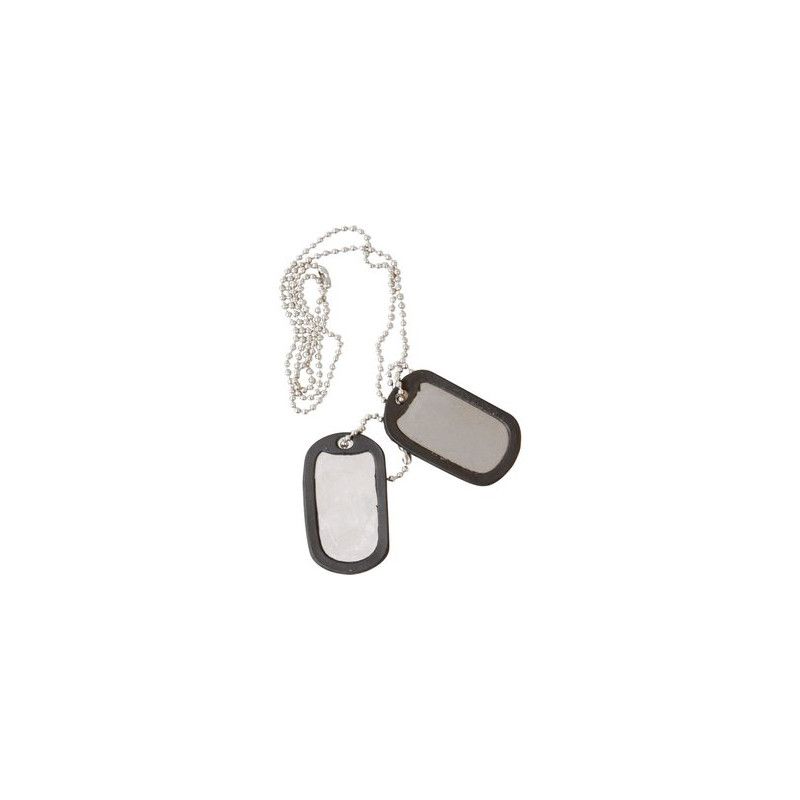

US Silver Plates - Kombat Tactical
Silencers for US plates - Kombat Tactical
1870: During the Franco-Prussian War, French soldiers begin to use aluminum or copper identification tags, similar to those used by soldiers from other countries.
1915: The French army officially adopted the use of identification plates for all soldiers, made of aluminum or silver.
1923: French military plates adopted an oval shape rather than rectangular.
1942: During World War II, the Free French Forces, led by Charles de Gaulle, adopt a new model of identity tag, with the soldier's name, rank and service number on one side, and the symbol of the Free French Forces on the other.
1952: The French army introduces new aluminum identity tags, on which the soldier's name, rank, blood type and service number are engraved.
1960s: The French army began using plastic identification plates on which the soldier's name, rank, blood type, and service number were printed.
1990s: The French army introduced new stainless steel identification plates, on which the soldier's name, rank, blood type, and service number are laser engraved.
Today: French military identity tags are still made of stainless steel and may include additional information such as the soldier's date of birth and religious affiliation.
To read a French military plate, you must start from the top to obtain the following information:
Last name
First name
Service number
Blood type
Unit or corps to which the military belongs
Some information, such as the first name, may be abbreviated to fit on the tag. Religion may also be indicated. Differences in the arrangement of information may also appear between identification tags of the Army, Navy or Air and Space Force.
For example, one could read on a military tag:
Dupont
Lucas
123456
O+
INF
The military wearing this tag is named Lucas Dupont, bears the service number 123456, has blood type O+ and belongs to the infantry.

The material used for military identification plates has evolved throughout history. In France, for example, the 1881 model for the army was made of nickel silver and worn with a flat black cotton lace. Subsequently, different materials were used, whether by the American army or the French army. Engraving methods and chains have also evolved.
Among the materials used, we find:
Aluminum: one of the first materials used for its lightness and durability.
Copper or brass: used by soldiers during the Civil War.
Silver: used by the French army for identification plates at the beginning of the 20th century.
Stainless steel : introduced by the U.S. Army in 1940, it is still today the main material used. Stainless steel is durable, corrosion-resistant and can be easily engraved or stamped with identification information.
Plastic: used by the French army in the 1960s for lightweight identification tags.
Electronic chips: In recent years, some armed forces have experimented with using "smart" materials like electronic chips containing medical and dental data.
Other metals: some civilian identification tags can be made from other metals such as gold, silver or titanium, for aesthetic or durability reasons.
Among the different engraving methods, we find:
Hand stamping: this is one of the first methods used to engrave identification tags. This method involves using a hammer and metal stamps to imprint identification information on the tag.
Embossing: This method involves printing identification information on the medal using a machine that creates raised letters and numbers.
Laser engraving: This modern engraving method uses a laser beam. Precise and durable, it is commonly used for military identification tags and some civilian identification tags.
Chemical engraving: it involves using acid to remove layers of metal from the surface of the medal, leaving the identification information engraved. Less common, it is still used for some personalized or handcrafted identification tags.
It should be noted that while engraving was once done by hand, laser engraving is now the most commonly used method in armed forces. Personalized military tags intended for civilian use may however use different engraving methods depending on durability, engraving precision, cost or individual preferences.
Are you military or passionate about the army? Find a wide selection of products from the biggest brands and always at the best price: military uniform, military boots, military equipment, materials and luggage.