 The best equipment for pros and enthusiasts alike

-
 Professions
-
-
-
-
-
-
-
-
All Tops
![All Tops]()
-
-
-
All Bottoms
![All Bottoms]()
-
-
-
All Footwear
![All Footwear]()
-
-
-
All Bags
![All Bags]()
-
-
-
All Accessories
![All Accessories]()
-
-
The adapted professional course, also known by the acronym PPA, is well known to candidates for the external competition for professional firefighters. Let's discover in this article what the PPA consists of as well as our advice for training and succeeding with flying colors!
Summary:
What is the adapted professional course (PPA)?
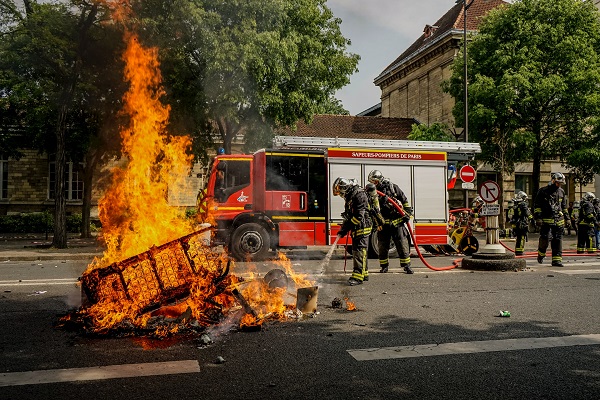
The adapted professional course, also called PPA, is part of the selection tests to become a professional firefighter. Indeed, the pre-admission physical tests include three tests, namely:
-
A swimming test: 50 meters freestyle without stopping in 50 seconds for men or one minute for women
-
An adapted professional course test
-
A cardio-respiratory endurance test of the Luc Léger type
The candidate is only allowed one attempt and a minimum one-hour break must separate each test. These tests allow to evaluate the endurance, the physical resistance of the candidate and his ability to carry out the missions of a professional firefighter. While the tests are the same for all candidates, the applied standards take into account the performance achieved and the candidate's gender.
What does the PPA consist of?
The adapted professional course (PPA) consists of six stages validated by an examiner who accompanies the candidate. The candidate must validate the stage before being able to move on to the next one. The allotted time is four minutes for men and five minutes and thirty seconds for women. All equipment is prohibited (gloves, knee protection...), except for chalk.
The six stages proceed as follows:
-
The candidate must complete a round trip on an 18-meter track with a dorsal load attached to an SCBA vest with a total mass of 22 kg with a possible variation of +/- 500g. Following this round trip, the candidate must hang from a pull-up bar with a minimum height of 1.90 m above the ground. On this bar is a central device. The candidate must then grasp each side of the bar with both hands while performing a translation.
-
The candidate, still equipped with his dorsal load, grabs an additional 20 kg sandbag-type load to cross a Swedish bench from end to end. The obstacle is 3 meters long, 25 cm wide and 30 cm high. At the end of the line, the candidate changes the load from one hand to the other and crosses the obstacle again.
-
The candidate takes a second 20 kg sandbag and performs 10 step-ups and step-downs on the Swedish bench. Both feet must be supported on the bench and the ground. Once completed, the candidate can put down one of the two sandbags to cross the line that marks the end of this stage.
-
The candidate puts down the 20 kg load to equip himself with another sandbag that weighs 10 kg. The candidate must then lift the load 10 times in a row up to a visual marker located 1.6 meters from the ground.
-
Stage 5 consists of bringing back a 40 kg load located 18 meters away by pulling on a rope. Once brought back to him, the candidate must turn the load over by the strap by passing under a 3-meter long obstacle. Once the load is placed back in its initial position, the candidate returns to his starting point by passing under the obstacle again.
-
For this last stage, the candidate must complete as many passes as possible on the 18-meter track while carrying a 20 kg load in each hand.
The first five stages earn the candidate one point each. At the end of stage 5, the candidate has therefore obtained 5 points. The sixth stage allows him to accumulate several points. Indeed, each validated 18-meter distance earns him one point. This last stage ends with the candidate's withdrawal, the end of the allotted time, or the completion of 15 lengths, which will allow the candidate to obtain the maximum score of 20/20.
Find the adapted professional course in video:
How to train to succeed in the adapted professional course?
To train for the adapted professional course, the simplest way is to get yourself a weighted training vest, to which you can add weight plates. You will thus be able to get used to supporting a 22 kg load on your back by gradually increasing the weight throughout your sessions.
A pull-up bar is useful to be able to train for stage 1. A simple piece of colored tape placed in the center of the bar will allow you to simulate the translation test. If you don't have a pull-up bar, you can sometimes find them in parks or public gardens.
The other essential equipment for training are the 10 and 20 kg loads. If you can, the ideal is to invest in sandbags, widely used in crossfit. These sand muscle-building bags exist in different sizes and weights. You can also opt for an adjustable weighted bag that allows you to gradually increase the load.
On vetsecurite.com, find a wide selection of products at unbeatable prices for firefighters, volunteers or professionals: clothing, shoes/boots, equipment, materials and luggage.
Related products
Related articles


-
![Over 200 brands At the best price]() Over 200 brands At the best price
Over 200 brands At the best price -
![Secure payment In 3 or 4 interest-free installments]() Secure payment In 3 or 4 interest-free installments
Secure payment In 3 or 4 interest-free installments -
![Delivery across Europe From €79 of purchase]() Delivery across Europe From €79 of purchase
Delivery across Europe From €79 of purchase -
![Customer service Monday to Friday]() Customer service Monday to Friday
Customer service Monday to Friday


